

Month twelve
The email arrives at 4:47 on a Thursday afternoon.
“After careful consideration we have decided to go in a different direction. We really appreciate everything the team has done.”
You read it twice. Then you open the account page, as if the dashboard might disagree with her. $180,000 a year. Ten features built because she asked for them. A 40% discount at the halfway mark. A dedicated success manager. Four quarterly reviews in which she said, on the record, that your team was “great to work with”.
She meant it. She liked you. She is leaving anyway, for a competitor with half your features.
Within an hour the thread has eleven people on it and four theories. Sales says product was slow. Product says sales oversold. Customer success says they flagged it in June. Finance wants to know why the forecast said 90%.
I am going to walk through this account month by month, because I think you have had this account. I have had it more than once. And the part nobody on that thread wants to hear is that this deal died in its first forty minutes, in a meeting everyone still remembers as a triumph. It just took a year for the body to turn up.
Month zero: the best demo you ever gave
Meera runs programmatic trading at a media agency that buys for about forty advertisers. Your company sells the campaign management and reporting platform her team would live in, as SaaS on an annual contract. She has blocked an hour. Your account exec has the demo down to forty minutes and it is good. Live campaign data, clean charts, and the bit where the pacing graph updates in real time always gets a reaction.
At minute thirty-eight he asks the question he was trained to ask.
“So, Meera. Would this solve the problem for you?”
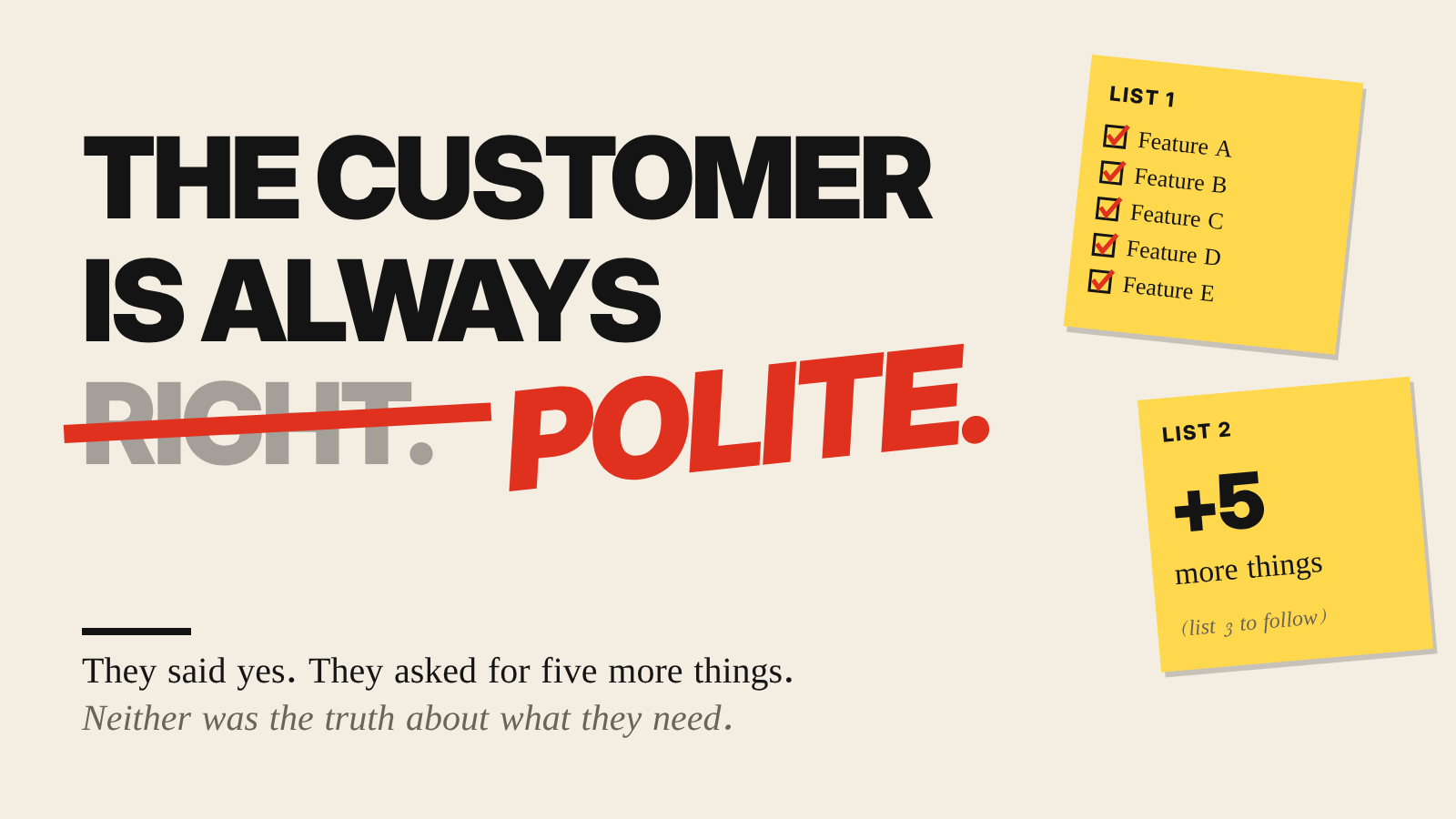
“Yes. Absolutely. You’d just need to add a few things.” She counts them on her fingers. An Excel export. Custom date ranges. Role-based views. A mobile view. Single sign-on.
Everybody writes down the five things. They go into an appendix of the contract called “Roadmap Commitments”. The contract is signed nine days later and somebody rings an actual bell.
Now look at what happened in that room.
Your rep showed a solution, named the problem on her behalf and asked her to agree, in front of her own team and yours. “No” would have been rude and would have made the last hour a waste of her time. “Yes” was free. So she said yes. And because a bare yes feels thin, she decorated it with requests.
Daniel Kahneman spent a career on this. In Thinking, Fast and Slow he calls it WYSIATI, “what you see is all there is”. The mind builds a confident story out of whatever is in front of it and does not go looking for what is missing. For forty minutes your product was the only thing in front of her.
“Nothing in life is as important as you think it is, while you are thinking about it.”
Daniel Kahneman
So Meera was primed. Your side was worse. You walked in wanting a yes, got one and stopped listening. That is confirmation bias and it was sitting in your chairs.
Nobody asked what she would do if she bought nothing. Nobody asked about the last time the problem had cost her something. And nobody wondered why the first thing a head of trading wanted from a reporting platform was a way to get the data out of it. Hold on to that one.
Rob Fitzpatrick wrote a short, rude book about this meeting called The Mom Test. Never ask your mum if your business is a good idea, he says, because she loves you and she will lie. His three rules fit on a sticky note:
“Talk about their life instead of your idea.”
“Ask about specifics in the past instead of generics or opinions about the future.”
“Talk less and listen more.”
Your demo broke all three in forty minutes and was logged in the CRM as a strong buying signal.
Shreyas Doshi, who led product teams at Stripe, told the same story in a thread in 2021. A PM asks customers whether a new product will solve their problems. “Customers say yes!” The project gets staffed. A few tweets later: “Hardly any customer adopts it”.


A yes that costs the customer nothing is worth exactly that much to you.
Month three: the second list
Engineering lost a quarter to it, but all five shipped on time, and you are a little proud walking into the review.
Meera is delighted. “This is great. Really. Now, if the export could run on a schedule. And custom columns. A pivot view would help. An API at some point. And PDF reports with our logo on them.”
Everybody writes down the five things.
Nobody says the obvious part out loud. The second list has nothing to do with the first. If the first five had been the problem, there would be no second five. A list that grows back every time you cut it is growing from a root you have not touched.
The usage data already knew. Her team logged in once a week, on Monday, before nine. The session lasted under three minutes and ended in an export. Your success manager put this in the quarterly deck as “Export feature adoption: 100%”.
This is how most products get built. Pendo’s 2019 Feature Adoption Report found that 80% of features in the average software product are rarely or never used, and that 12% of features produce 80% of daily usage. It put the R&D that public cloud companies had sunk into the unloved 80% at up to $29.5 billion.
Four out of five things your engineers built, and somebody in a meeting said yes to every one. Your roadmap is mostly a record of people being polite to your sales team.
We call this being customer-centric. I have come to think it is closer to the opposite.
Building what the customer says is the cheapest way to avoid finding out what the customer needs, and it comes with an excuse already attached: they asked for it.
The coffee: what she would have told you
Three weeks after the email you buy Meera a coffee. No pitch, you tell her. You just want to understand.
She is almost embarrassed.
“Honestly? Your numbers never matched finance. You count an impression the moment the bid is won. Our finance team bills clients on what the ad server says was actually delivered. Some weeks the gap was ten percent. So every Monday I exported everything into Excel and fixed it by hand before my CFO saw it. He had stopped trusting any report that came from my team. I was about six months from losing my budget.”
“Why didn’t you tell us?”
“I asked for the export on day one. Nobody asked me why.”
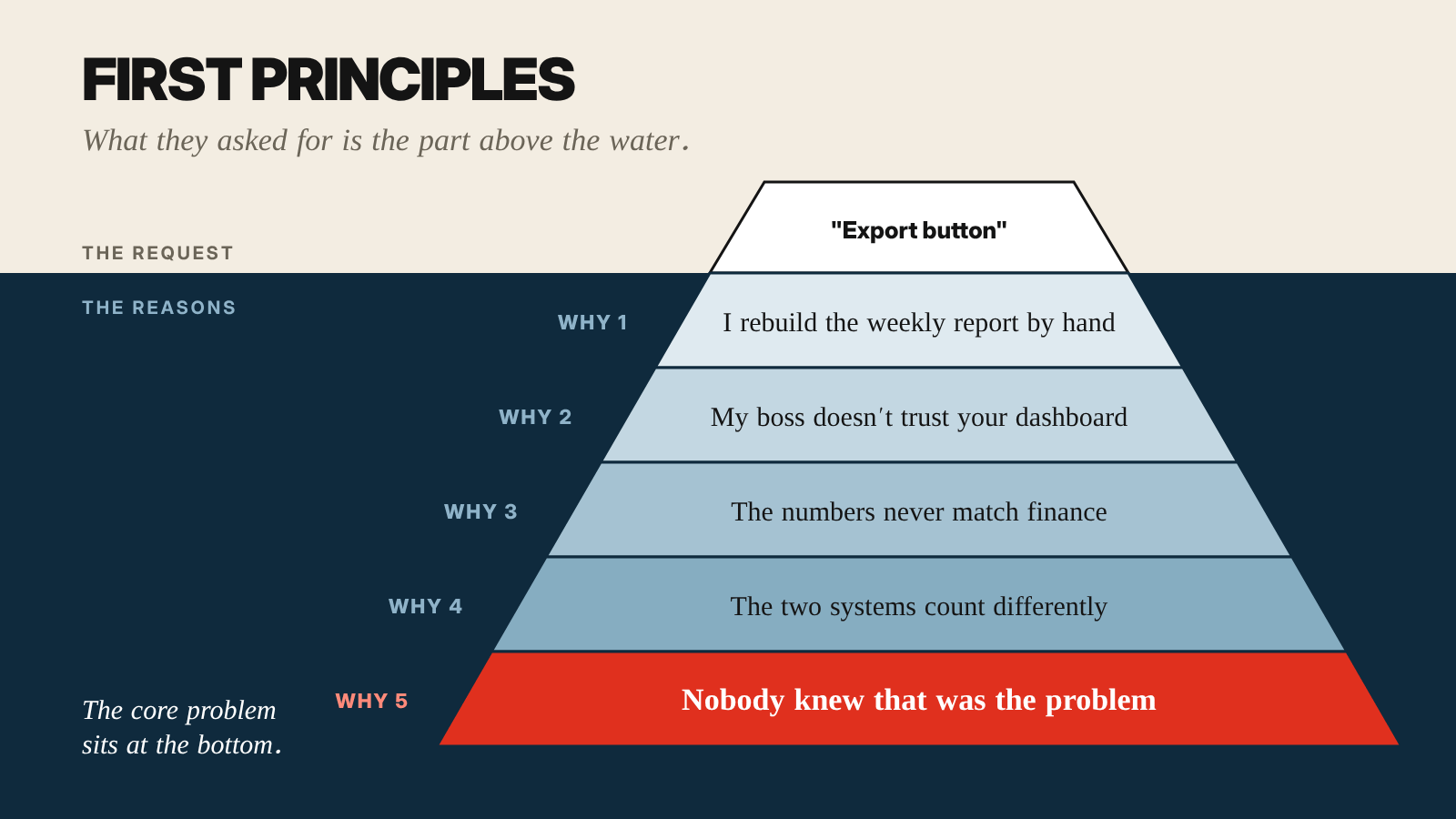
That is the whole case. Every item on both lists was Meera trying to assemble, out of your product and a spreadsheet, one number her CFO would believe. The vendor she moved to has an ugly interface and no mobile app. It reconciles against the ad server and feeds the billing system, so the numbers match. She bought the match.
It would have taken five questions in month zero to find this. Taiichi Ohno built the Toyota Production System on the habit of asking why five times before anyone touched a tool.
Why do you need the export? Because I rebuild the weekly report by hand.
Why by hand? Because my CFO doesn’t trust your dashboard.
Why not? Because the numbers never match finance.
Why don’t they match? Because the two systems count an impression differently.
Why has nobody fixed that? Because nobody on either side knew it was the problem.
People hear “first principles” and think of rockets, which is why they don’t use it on Tuesdays. Elon Musk’s best-known example is duller and more useful. In a 2012 interview he described what everyone in the car industry knew: battery packs cost $600 per kilowatt hour and always would. So he asked what a battery is made of. Cobalt, nickel, aluminium, carbon, some polymers, a steel can. Then he asked what those cost on the London Metal Exchange. “It’s like $80 per kilowatt hour.”
The $600 was a fact about what the industry was used to paying. Everyone else was reasoning by analogy, which is a polite term for copying the last person’s homework. “The competitor has an export, the client asked for an export, build the export” is the same homework.
Clayton Christensen told a version with less software in it. A fast-food chain wanted to sell more milkshakes, so it asked milkshake buyers what the ideal shake would be and made the changes. Sales did not move. Then a researcher stood in a restaurant and watched. About 40% of the milkshakes were sold first thing in the morning to commuters who drove off with them. In Christensen’s words they “faced a long, boring commute and needed something to keep that extra hand busy”. The milkshake was competing with a bagel. The customers had answered every survey question honestly and every answer was useless, because the questions were about the milkshake.
Meera answered every question honestly too.
A customer who bought because the pitch was good has bought the pitch. The product still has to audition.
Richard Feynman told the Caltech class of 1974, “The first principle is that you must not fool yourself, and you are the easiest person to fool.” He was talking about science. It applies without changes to a pipeline review.
Month six: two decisions that took ten minutes
Go back to month six, knowing what you know now.
Meera mentions on a call that there is “a budget review coming”. It is true, and you now know whose budget. Your side hears a negotiating tactic. Two decisions get made that week, each in under ten minutes.
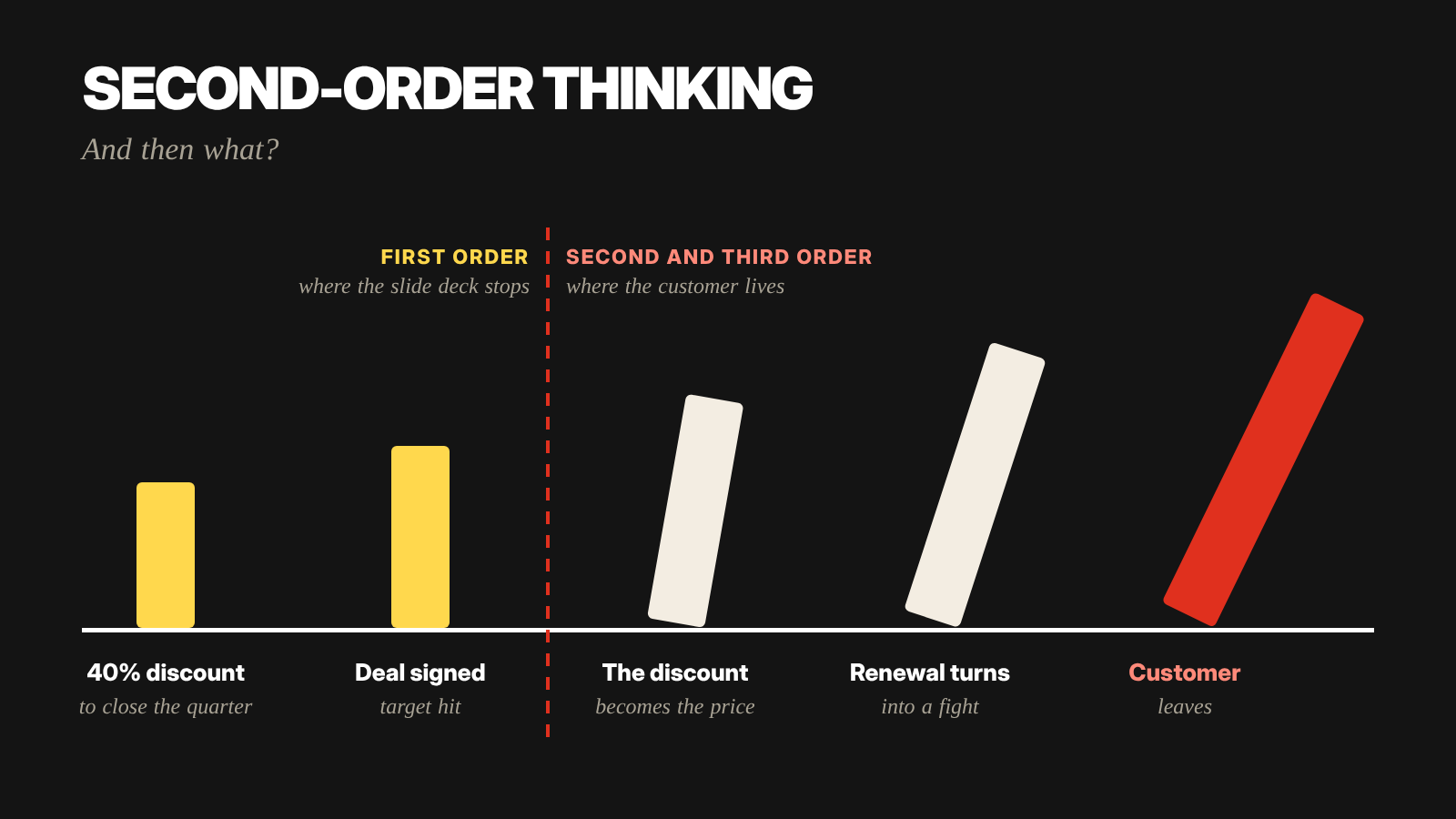
The sales VP approves 40% off “to protect the relationship”. And the CTO, leaned on by the sales VP, agrees to build the pivot view as a one-off for this account only.
Both felt decisive. Howard Marks, co-founder of Oaktree Capital, has a name for this kind of decisiveness. In The Most Important Thing and in a 2015 memo he calls it first-level thinking.
“First-level thinking is simplistic and superficial, and just about everyone can do it.”
Howard Marks
His first-level investor says, “It’s a good company; let’s buy the stock.” His second-level investor says, “It’s a good company, but everyone thinks it’s a great company, and it’s not. So the stock’s overrated and overpriced; let’s sell.” The ecologist Garrett Hardin got the whole discipline down to three words: “And then what?”
Nobody asked them in month six, so ask them now.
The discount. And then what? The discount becomes the price. And then what? You have just told Meera’s CFO, a man who already doubts your numbers, that the product was worth 40% less than you had been charging him. You cut the price of a thing he didn’t believe in and called it relationship management.
The custom build. And then what? You now maintain a private version of your product. And then what? Every release gets tested twice, and the roadmap for your other two hundred customers slips a quarter. They don’t complain. They start taking calls from your competitor.
The weekly check-in your success manager started. And then what? A person is now absorbing the pain the product should have removed. And then what? Cost to serve goes up, margin goes down, and product never finds out anything was wrong.
If this sounds like a small-company problem, Wells Fargo ran the same play at scale. The bank wanted every household to hold eight of its products. The slogan was “eight is great” and branch staff got targets to match. First-order result: cross-sell numbers the whole industry envied. Nobody with authority asked what a teller does when the target can’t be hit honestly. In September 2016 regulators answered. Staff had opened more than 1.5 million deposit accounts and 565,443 credit cards nobody had asked for. The bank fired 5,300 people and paid $185 million.
Economists call it Goodhart’s law: when a measure becomes a target, it ceases to be a good measure. If your reps are paid on bookings and nothing else, you have built a small Wells Fargo and you are waiting for the result.
Or take MoviePass. In August 2017 it cut its price to $9.95 a month for a cinema ticket every day. Subscribers went from 400,000 to more than 3 million in under a year. And then what? MoviePass was paying cinemas full price for those tickets. Every new subscriber who liked films made the hole deeper. It shut down in 2019 and its parent went bankrupt months later. Growth was the first-order effect and bankruptcy was the second. The slide deck only had room for one.
First-order thinking gets you to the end of the quarter. Second-order thinking gets you a second year.
Month nine: the war room
By month nine the account is flagged red and has its own weekly meeting. Fourteen people. You have seen the agenda before.
Do we build the API now or next quarter?
Do we put a second success manager on it?
Do we extend the discount?
Do we fly out for an executive dinner?
Do we fix the mobile view she complained about?
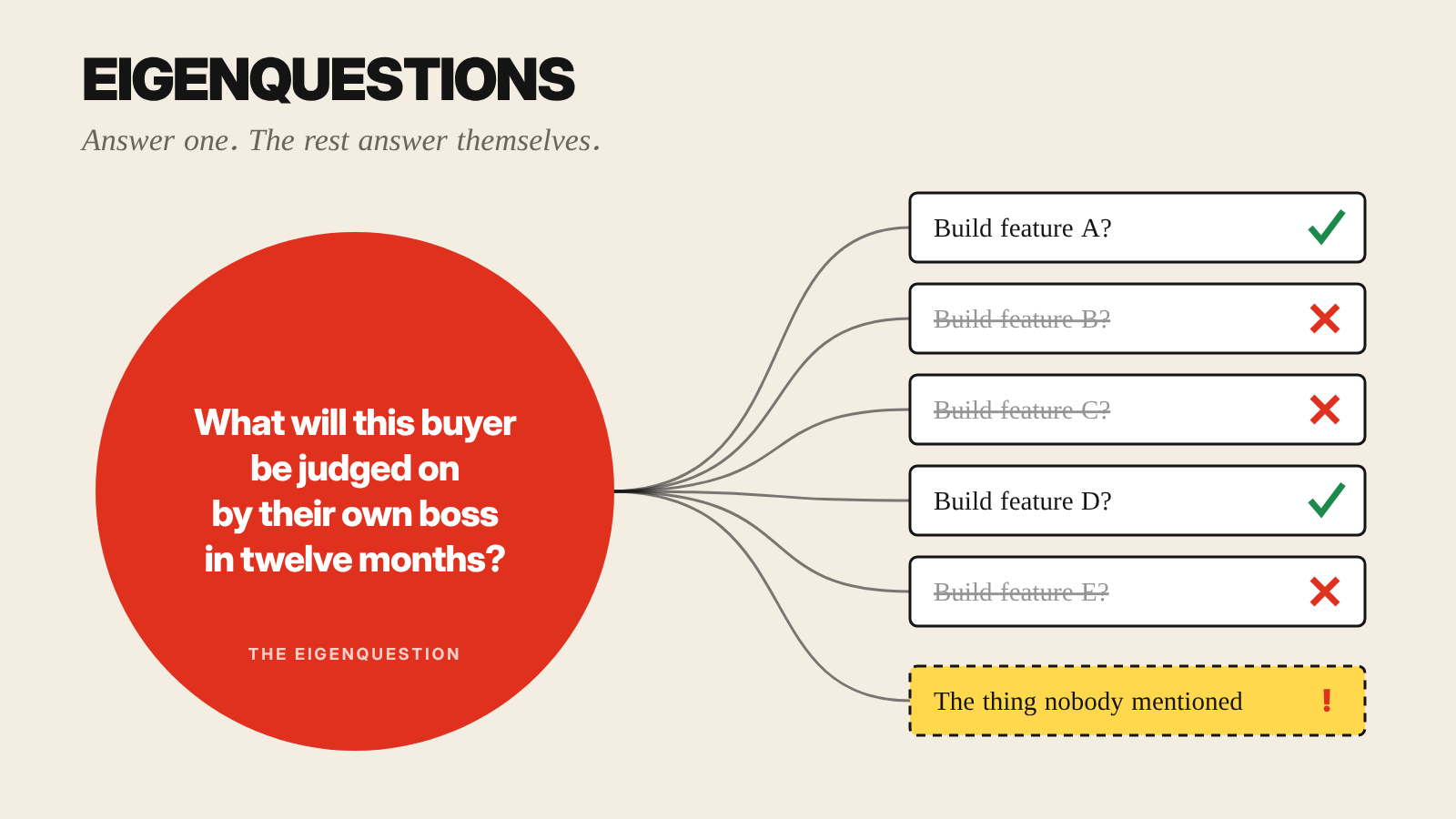
Five questions, five owners and about five opinions per question. The meeting runs ninety minutes a week for eleven weeks. That is roughly 230 hours of expensive people, and in none of those hours does anyone ask the one question that would have closed the other five:
What will Meera be judged on by her own boss twelve months from now?
The answer was one delivered-impressions number her CFO believes. Hold the agenda up against it. The API doesn’t matter. The dinner doesn’t matter. The mobile view never mattered. And a sixth item that was on nobody’s list, reconciling with the ad server and billing, decides the renewal.
Shishir Mehrotra, co-founder of Coda and before that the person running product at YouTube, has a word for that kind of question. He made the word up, borrowing from linear algebra, and he is cheerful about it.
“The eigenquestion is the question where, if answered, it likely answers the subsequent questions as well.”
Shishir Mehrotra

His own example is from his early days at YouTube. The company had a recurring fight. When someone searched for a show YouTube didn’t have, say Modern Family, should the results link out to the site that did? Product and engineering said yes, because that is what a good search engine does. The business side said no. It could have run for years.
They got out by asking a different question. In online video, does consistency matter more than comprehensiveness? They looked at shopping. Google Product Search covered far more of the web than Amazon did, and people still chose Amazon, because every Amazon purchase worked the same way. Consistency won. That one answer settled the link question, and then it went on settling things nobody had put on the agenda: whether creators could opt out of certain devices, whether to allow third-party embedded players, whether YouTube should build its own iPhone app instead of relying on Apple’s.
Reid Hoffman said he has used the framework “in both companies and investments”.


Most tech companies are carrying two or three unanswered eigenquestions around and paying for them in meetings.
Are we a product company, or a services company with a login page? That one answers custom work, pricing, hiring and the margin you can ever expect.
Is our customer the person who signs or the person who logs in? That answers the roadmap, the onboarding and who customer success should be calling.
Do we get paid when the customer succeeds or when the customer signs? That answers the comp plan, the forecast and most of the churn.
There is a simple test. If you answered the question today, how many other open questions would close by themselves? If the number is zero you have a task, and you should stop calling it strategy.
Most roadmap fights are five people answering five different questions and calling it a disagreement.
The post-mortem nobody held
The churn did get a post-mortem. It lasted forty minutes and produced an action to “improve cross-functional alignment” and a new dropdown in the CRM.
The real one would have been shorter and far less comfortable. Every team on that account did its job. Each answered a question, and each skipped the one sitting behind it.
Sales asked what gets this signed by quarter end. It never asked what happens to Meera if she buys nothing.
Product asked what the customer wants. It never asked what she was trying to get done and why that was hard.
Engineering asked how fast it could ship. It never asked what the one-off would break for everyone else in two years.
Customer success asked how to keep her happy. It never asked why she only logged in on Mondays.
Finance asked whether bookings were hit. It never asked whether this revenue would come back or what it cost to keep.
The first question in each pair is the one that gets you promoted. It is measurable, it fits in a weekly update and it can be answered by Friday. The second has no dashboard, so it loses every time.
This is also why your teams quietly despise each other. Engineering thinks sales will sell anything. Sales thinks product never ships what the market wants. Customer success thinks everyone upstream lied. Finance thinks nobody can forecast. All four are describing the same missing conversation from different floors of the building.
Jeff Bezos saw it coming. In his 2016 letter to shareholders he warned that “market research and customer surveys can become proxies for customers”. The request, the ticket, the survey score and the bookings number are all proxies. Your company hit every one of them on this account. Ten features delivered on time. Quota made. Meera gave you a nine on the satisfaction survey the month before she left.
If you want the expensive version, there is Quibi. Jeffrey Katzenberg and Meg Whitman raised $1.75 billion for premium short video on phones. It launched in April 2020 and announced its shutdown about six months later. The founders’ farewell letter said it failed either “because the idea itself wasn’t strong enough to justify a standalone streaming service or because of our timing”. Two of the most experienced operators in media and tech, nearly two billion dollars, and whether anyone needed the thing was established after launch.
Churn gets booked against customer success. On this account it was manufactured in sales, approved by product and paid for by engineering.
Churn is a decision the customer made in month two and told you about in month twelve.
Next Thursday
There is another demo next Thursday. Different company, same forty minutes, same rep, same pacing graph. At minute thirty-eight he is going to ask the question.
None of what follows needs a transformation programme. It needs a few rules that are mildly annoying to keep.
Retire the question. “Would this solve your problem?” is banned. Ask about the last time the problem happened. What did she do, who got shouted at, what did it cost? If she can’t remember a last time, you have your answer and it is cheaper than a year of finding out.
Five whys before any ticket. Every customer request gets its chain of whys written down before it gets an estimate. If the chain stops at the second why, you don’t know enough to build anything.
Two lines of “and then what?” on every approval. Discounts, one-off builds, headcount. Whoever asks for it writes the second and third consequence. Four minutes of typing would have saved this account.
Name the eigenquestion before the meeting starts. If the room can’t agree what it is, that argument is the meeting.
Pay sales partly on renewal. People think one step ahead when they are paid one step ahead.
Steve Jobs told a hostile questioner at Apple’s developer conference in 1997, “You’ve got to start with the customer experience and work backwards to the technology.” Everyone in this industry can quote that line. Most roadmaps still start with the technology, or with whatever the last sales call wanted.
I should be honest about my own record. After more than two decades of this I still catch myself asking the leading question. It is a comfortable question. It gets a comfortable answer and the meeting ends on time. The other kind of question makes the room go quiet and sometimes makes the deal smaller.
Charlie Munger had a line for anyone hoping it gets easier: “It’s not supposed to be easy. Anyone who finds it easy is stupid.”
So on Thursday, when she says “yes, absolutely, you’d just need to add five things”, try not writing them down. Put the pen on the table. Ask her what happens to her if you never build any of it. Then stay quiet for longer than is comfortable.
Somewhere in what she says next is the reason she will still be a customer in three years, or the reason she was never going to be one. Either is worth more than the bell.
The account in this piece is a composite. Each part of it has happened on a real account, some of them more than once.
Sources and further reading
Books: Daniel Kahneman, Thinking, Fast and Slow. Rob Fitzpatrick, The Mom Test. Clayton Christensen, Competing Against Luck. Howard Marks, The Most Important Thing. Taiichi Ohno, Toyota Production System.
Reports and articles: Pendo 2019 Feature Adoption Report. Elon Musk on first principles, CNBC. Clay Christensen’s Milkshake Marketing, HBS. Howard Marks, “It’s Not Easy”. Wells Fargo fires 5,300. MoviePass, Wikipedia. Shishir Mehrotra, Eigenquestions. Jeff Bezos, 2016 Letter to Shareholders. Quibi shutdown, PBS NewsHour.