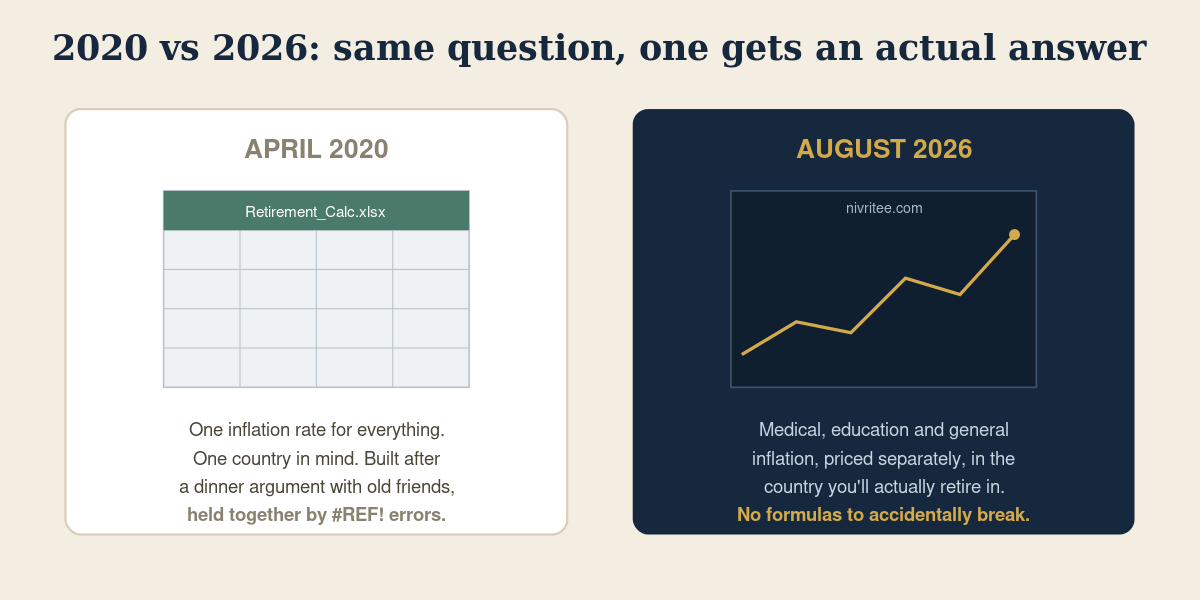
Six years ago I built a spreadsheet at midnight during a lockdown, convinced I had cracked retirement planning. This year I turned 48, opened that same file, and laughed at myself the way you laugh at photos from your first job.
Let me back up.
In April 2020, stuck at home with the whole world on pause, I wrote a post called “How Much Money Is Enough In My Bank Account As Retirement Corpus If I Decide To Quit Active Professional Life Someday”. Catchy title, I know. My editor, who does not exist, was on leave that year.
The post started with a story that was true then and is truer now. A year before Covid, five of us who used to work together in our twenties met for lunch that turned into dinner. We were all past 40. Somewhere between the second round of stories about how we survived on borrowed hundred-rupee notes and the first round of complaining about school fees, someone said the word retirement out loud, and the table went quiet in that specific way tables go quiet when everyone realises they’ve thought about something a lot and discussed it with no one.
Everyone had an opinion. One friend said a corpus of a crore was plenty. Another said you needed a lakh a month and that was that. Within ten minutes, five men who couldn’t tell you the service tax on the food in front of them were speaking with total confidence about GDP, inflation, and the “real” cost of living. It was equal parts hilarious and unsettling, because underneath the bravado, nobody actually had a number. We just had vibes and old-fashioned bank fixed deposits.
That dinner sat in my head for a year. Then the lockdown gave me the two things every mediocre spreadsheet needs, which is a lot of free time and an inflated sense of my own Excel skills. I built a simple retirement calculator. Put in your monthly expense, your years to retirement, an assumed rate of inflation, an assumed return on investments, and out came a number. I was genuinely proud of it. I shared it. People downloaded it. It did the one job I built it for, which was to make the problem visible instead of vague.
But here’s the thing about a spreadsheet you build in one sitting at 47 years and 46 weeks of age. It carries every shortcut you took while building it. Mine assumed one flat inflation rate for absolutely everything, groceries, school fees, and a hospital stay, as if a heart bypass gets 4% more expensive a year in the same tidy way that a loaf of bread does. It assumed one country, one currency, one version of the future. It had no idea what would happen if the market fell 30% the year after I stopped earning. And if you so much as breathed near a cell in the wrong order, the whole thing would helpfully return #REF! and stare back at you in silent judgment.
It was a good first draft of an idea. It was not, in hindsight, a plan.
I’ve thought about this a lot more since, mostly because I no longer have the luxury of thinking about retirement as a someday problem. I am turning 48 this year. Whatever number my friends and I threw around casually over dinner in 2019 is no longer a hypothetical for a future version of me. It belongs to a version of me that shows up in about a decade, give or take, and that version is currently very interested in whether present-day me did his homework.
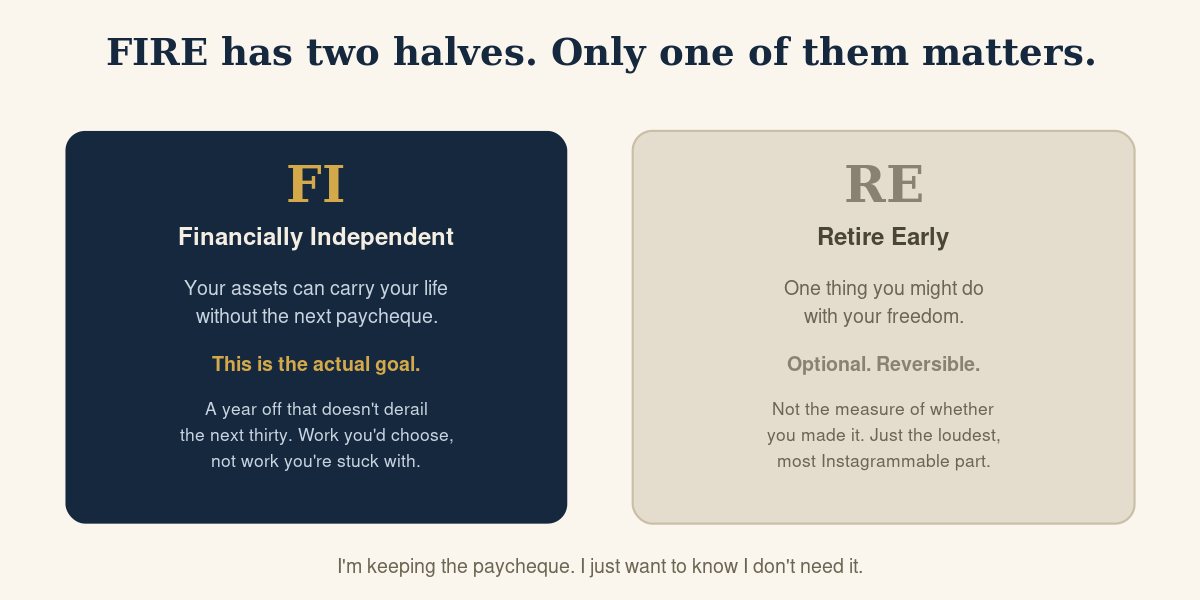
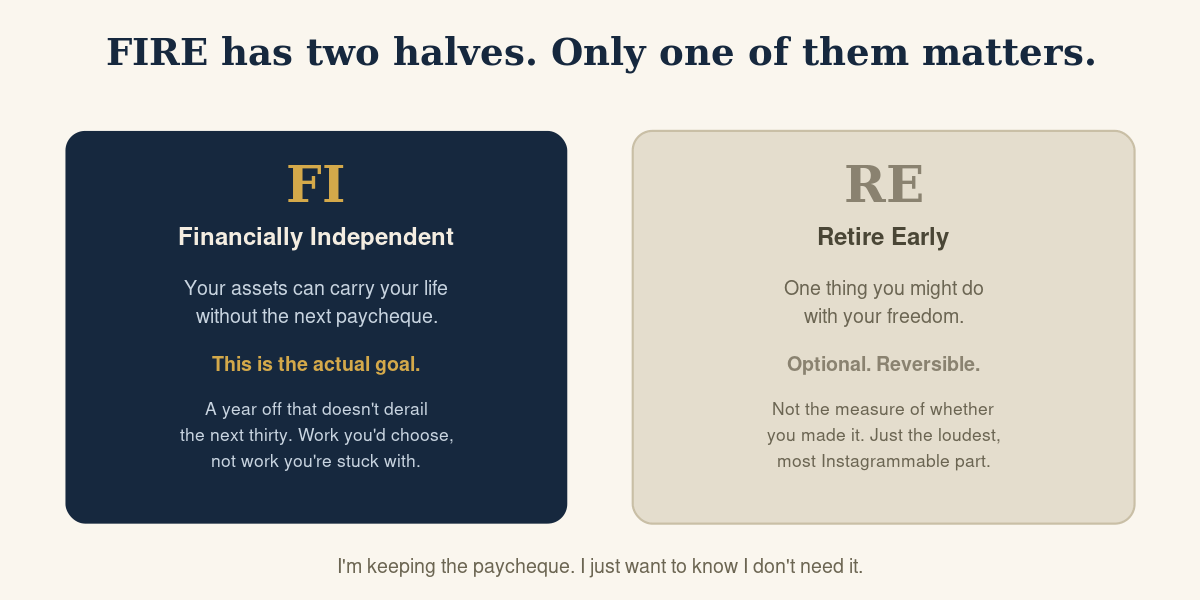
Here’s what I’ve come around to, slowly and with the usual amount of denial: the goal was never really early retirement. The goal is independence, and retiring early is just one of the more dramatic things you can choose to do with it once you have it. Nobody puts “quietly not needing anyone’s paycheque” on a vision board, but that, quietly, is the whole point. Financial independence buys you the year off that doesn’t wreck the next thirty. It buys you the ability to walk into a bad boss’s office and mean it when you say no. It buys you the freedom to take the startup swing where failure costs you time instead of your house. It buys you the ability to be in the room when your parents or your kids actually need you there, not the version of you that’s checking Slack under the table.
FIRE gets remembered for its second half, the retiring early bit, because that’s the part with the beach photos. The first half, being financially independent, is the actual achievement. The second half is optional. That reframe alone was worth more to me than any spreadsheet formula.
So this year, instead of patching my own file for the fourth time, I went looking for something built by people who clearly also sat through a dinner like mine, took it more seriously than I did, and then went and built it properly. That’s how I landed on Nivritee, and it’s basically my 2020 spreadsheet if it had gone to business school, hired a good CFO, and stopped assuming I still live in the same city forever.
A few things it does that made me want to write this post instead of quietly using it in peace.
It splits inflation into general, medical, and education, instead of pretending your kid’s college fee and your monthly grocery bill move at the same pace. They don’t, not even close, and treating them the same is exactly the mistake my old sheet made.
It runs in the actual currency and economic conditions of the country you’ll be living in, across eleven countries, rather than converting some generic global number into rupees or dollars and hoping for the best. Where I live, work, and retire changes the answer, so the tool should actually know that instead of assuming everyone’s plan looks like a slightly discounted American one.
It gives you a year by year ledger, not just a single scary or reassuring number at the end. Opening savings, income, growth, spending, loan payments, every year until you’re 85 or beyond, so if a figure on the dashboard surprises you, you can actually trace it back to the row that caused it. My old file gave you one output cell and a prayer.
It stress tests the plan against things that have actually happened, a 2008 style crash, a long stretch of high inflation, living ten years longer than you planned for, rather than assuming the next forty years go exactly as smoothly as the last five slides of a mutual fund brochure.
There’s also a planner in there named Niv, who you can ask “what if I stop at 55 instead of 60” and she reruns the whole projection with your real numbers instead of guessing. She’ll tell you plainly if the plan holds or if it’s thin, which is more honesty than I got from most of the finance influencers I ignored during that lockdown.
And nobody reads what you type in. Not a human on their end, not me, nobody. That mattered to me more than I expected it to, given that I was about to type in every uncomfortable number about my own finances into a website built by strangers.
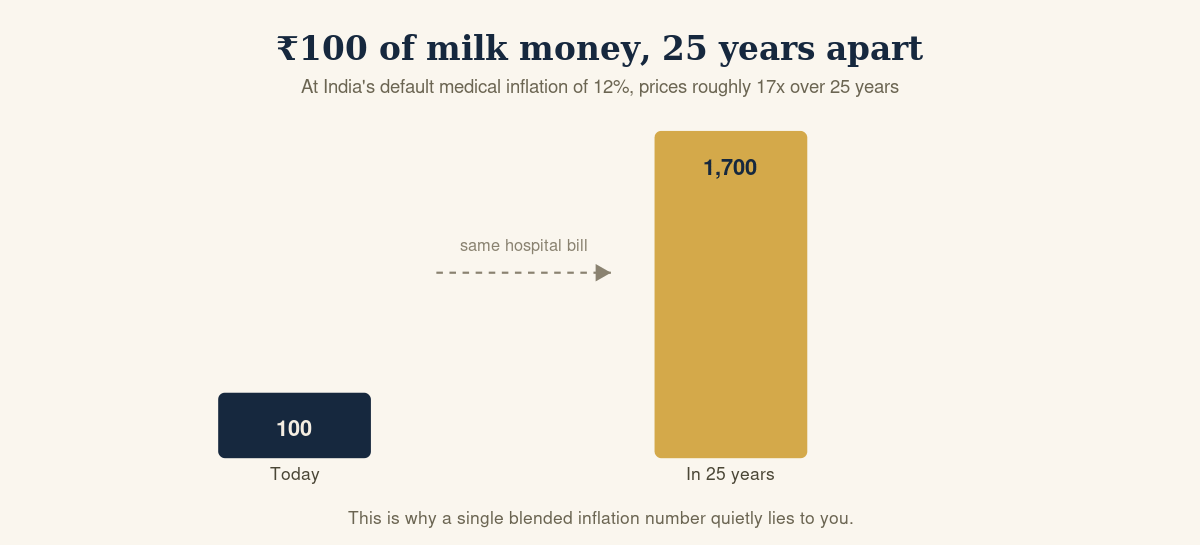
Here’s the part that actually got under my skin a little. I plugged in numbers close to my real ones, out of morbid curiosity more than discipline, and the tool quietly told me the year my kid’s university fees would land and how much that single year would spike my spending above everything around it. My 2020 spreadsheet never once mentioned that. It just averaged everything into one smooth, comforting, and completely wrong line.
I’m not going to pretend I’ve fully made peace with 48. There’s a specific kind of vertigo that hits when you realise you’re now the “40+ guy at the dinner table” that a younger version of you used to eavesdrop on with mild pity. But I’ve made peace with the number that matters more than my age, which is the number that tells me whether I’m actually free or just assuming I am.
If you’ve ever built your own version of that midnight spreadsheet, or if you’ve never built one because the whole thing felt too vague to even start, go find out what your number actually is. It takes about ten minutes, you can change every assumption it makes, and if the answer makes you a little uncomfortable, that’s kind of the point. Better to know now than to find out at a dinner table twenty years from now.
Go try Nivritee. And if you’re curious where this obsession of mine started, the old spreadsheet post is still up, #REF! errors and all.