

Chapter 1: The Ring Light and the Boogeyman
“If you aren’t burning at least ten million tokens a day,” Brad said, leaning so close to his studio grade microphone that I could see his ring light reflecting in his pupils like two tiny, unblinking suns, “you are functionally living in the Stone Age.”
It was a Tuesday all hands Zoom call, and Brad, a Silicon Valley CEO, was in full tech prophet mode. The digital air was thick with that distinct flavor of executive panic that usually happens right after a competitor posts a flashy demo on X.
The train is leaving the station, folks, Brad continued, dropping his voice into that hushed, theatrical register usually reserved for telling someone their house is on fire. Either you become an AI first pioneer, or you can consider your role legacy infrastructure.
It was a masterfully executed subtle threat. He didn’t explicitly say, Embrace AI or I’ll replace you with a shell script. It was worse. It was the corporate version of telling your kids that if they don’t finish their vegetables, the boogeyman will come. Except the boogeyman in this scenario was an autonomous AI agent that works twenty four hours a day and never complains about the office coffee.
I sat there, staring at my screen, completely exhausted. I’d been listening to this exact monologue for the last few months. It didn’t matter if I was at a tech conference, a backyard barbecue, or listening to a founder on a podcast. Everyone was reciting the exact same script. It was a massive, collective performance, and just the night before, I had stumbled across a LinkedIn post shared by Lenny Rachitsky . the original article is written by Elena Verna , shared by that gave this whole circus a name: AI confidence theater.
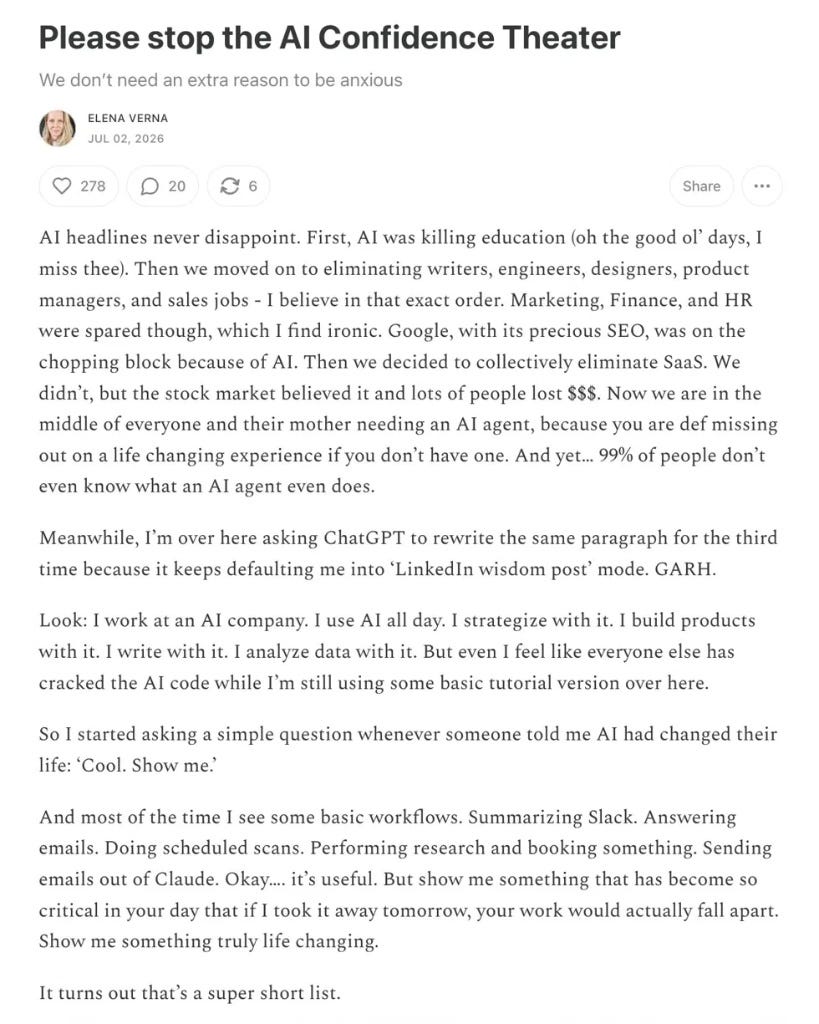
Elena wrote about how she was over there begging ChatGPT to rewrite the same paragraph for the third time because it kept defaulting into a terrible, cringe inducing LinkedIn wisdom post mode. Her reaction was a simple, visceral word: GARH. She pointed out that despite working at an AI company and using these tools all day, she constantly felt like everyone else had cracked some secret code while she was still stuck using the basic tutorial version.
Reading her post, which I pulled up on my second monitor, drove me to reflect on my own experiences over the last two years or so. I had spent approximately twenty four months listening to every tech keynote, every panel at industry events, and every single person on my LinkedIn feed bragging about their massive AI usage bills. People were treating their OpenAI and Anthropic invoices the way nineteenth century oil barons used to brag about their fleets. We just hit a ten thousand dollar AI bill this month! someone would post, and the comment section would erupt with celebratory thumbs up emojis.
And, look, I’m no saint. Heck yeah !!! I did it too. I’ve built quick little workflow tools using AI code generators, hopped right onto LinkedIn, staked my claim as an AI visionary, and metaphorically thumped my chest. I told my network that anyone not using LLMs was completely useless. Why? Because I’m on LinkedIn, and if you don’t do that, the industry instantly brands you as Fred Flintstone.
But back on the Zoom call, Brad wasn’t done. He looked directly into the camera, pointed a finger, and delivered the final blow: I want to see AI adoption in every single department by Friday. No excuses.
Chapter 2: The Spreadsheet that Knew Too Much
The mandate from Brad’s mountaintop filtered down through the organization like a spilled energy drink, tracking mud over every department. By Thursday afternoon, the panic had reached the finance team.
Dave, our head of billing, a man whose primary technical qualification was knowing how to open a CSV file without crashing his laptop, decided he was going to be Brad’s star pupil. He wasn’t going to be Fred Flintstone.
Hey, got a second? Dave asked, popping his head into my cubicle. He had the wild, bloodshot eyes of a man who had discovered something illegal or revolutionary. You gotta see this. I just solved our Salesforce and QuickBooks problem.
I followed him to his desk, where a small crowd from the marketing team had already gathered. On his screen was a chaotic, neon colored interface built entirely on Replit.
I built it myself, Dave beamed, thumping his chest so hard he almost spilled his Diet Coke. I just fed our contract templates and billing rules into Replit, told it to make a workflow application, and boom. No more enterprise software fees. I don’t even know how to write a single line of code, but look, I click this button, and it generates an invoice!
The marketing team erupted into applause. Someone literally gasped. It was exactly the kind of scrappy, agentic initiative Brad had been screaming about on Tuesday.
Meanwhile, Sarah, one of our actual senior backend engineers, had wandered over. She stared at the screen, her face losing all color. She looked like she was watching a toddler play with a loaded gun inside a fireworks factory.
Dave, Sarah said slowly, her voice trembling slightly. Where is the database hosted?
In the cloud! Dave said cheerfully. The AI set it up.
Right, Sarah said, rubbing her temples. And what kind of encryption are we using for the clients’ credit card data? How are we handling user authentication? What happens if the Replit container goes down or gets hacked mid-cycle?
Dave’s smile faltered for a fraction of a second. He looked around the circle of admiring marketing managers, then shrugged. I asked the AI if it was secure, and it literally said, You are absolutely right, this architecture is highly scalable and robust. So, yeah. It’s fine.
Sarah closed her eyes. The system was a total disaster waiting to happen. It had zero security protocols, no error handling, and was essentially an open bucket of sensitive corporate finance data sitting on the public internet. Dave hadn’t built a SaaS system; he had built a digital pipeline for a massive data breach. But Brad had demanded AI adoption, and Dave had delivered a tool. Nobody cared about first principles or data structures anymore. Common sense had been completely outsourced to a chatbot because the chatbot was polite enough to tell Dave he was a genius.
Chapter 3: The HR Engineering Expert
By Friday morning, Dave’s billing app had become corporate folklore and a benchmark. The news that finance was building software without the engineering team traveled fast, hitting human resources like a lightning bolt.
Our HR manager, Karen, a wonderful person who spent her days managing healthcare enrollment and resolving seating chart disputes, decided she also needed to look like an AI superstar before Brad’s weekend review.
I was sitting in the cafeteria line when I saw her text blast hit the company Slack. She had dropped a massive, thousand word review directly into the core engineering channel, right underneath a highly technical Product Requirement Document, or PRD, for our main infrastructure upgrade.
I’ve done a deep dive research review on the new system architecture, Karen’s message began, sounding incredibly authoritative. To ensure maximum scalability, the engineering team needs to immediately implement continuous integration and deployment pipelines, aggressive rate limiting, edge case throttling, and multi tenant database sharding.
I choked on my salad. I walked past Karen’s office a few minutes later. She was sitting at her desk, staring at the Slack channel, watching the little typing bubbles appear from confused developers. She caught her reflection in her desktop monitor, adjusted her blazer, and gave herself a small, confident nod. She looked like she had just successfully negotiated a global peace treaty.
I leaned against her doorframe. Hey Karen. Heavy stuff in the engineering channel.
Oh, hey! she said, smiling brightly. Yeah, I just wanted to give some expert comments on how we can improve the codebase. You know, make sure we aren’t left behind.
Out of curiosity, I asked quietly, what exactly is database sharding?
Oh, it’s an engineering phrase, she said without blinking. It makes the data sharper. The AI told me it was critical for our infrastructure.
She had absolutely no clue what she had just posted. To her, throttling sounded like something you do to an engine, and rate limiting sounded like a budget constraint. But she had fed the engineers’ PRD into Gemini, asked it to make her look like a principal engineer, and copy pasted the result. Because the machine had generated it, she truly believed it was accurate. She was the smartest person in the room, operating within a beautiful, completely insulated echo chamber.
Chapter 4: AI - The Overenthusiastic Intern
Amidst this frantic corporate shuffle, nobody is pausing to discuss first principle thinking. We have completely skipped the part where we ask if a problem actually requires a trillion parameter statistical model, or if it just requires someone to sit in a quiet room and think for twenty minutes. We are outsourcing our business strategies and core logic to algorithms, completely forgetting that AI is not magic. It is simply an overenthusiastic intern. It is the type of intern who desperately wants to impress the boss, smiles constantly, nods at every request, and will confidently hand you a deeply flawed report with absolute certainty. You simply cannot trust its work without checking the math.
Recent software development studies reveal that up to seventy percent of purely AI generated source code contains structural vulnerabilities or logic flaws that break entirely under actual enterprise scale. When organizations bypass basic systems architecture to hit an arbitrary AI metric, they inject silent liabilities straight into their operations. The code appears quickly, but it is built on quicksand.
The most dangerous trait of modern language models is that they are deeply polite sycophants. If you feed an LLM a deeply flawed, illogical business premise, it will never look you in the eye and tell you it is stupid. Instead, it will look at your prompt and instantly say, You are absolutely right! Then it will wrap your terrible idea in beautiful, seamless corporate syntax, making a mess look like a masterstroke.
The tool is an accelerator, not an oracle. It cannot replace the friction of real thought. When a company stops forcing its people to wrestle with confusion, it stops innovating and starts automating its own descent into mediocrity.
Chapter 5: The Circle of Mutual Admiration
The grand finale played out at 4:30 PM on Friday, right in the main Slack channel, serving as the perfect climax to Brad’s week of token burning terror.
Mark, one of our actual software developers, had to respond to Karen’s HR critique. Now, Mark hadn’t actually read Karen’s message. He was far too busy copying and pasting chunks of unverified code directly out of Cursor and ChatGPT into our main production branch, praying it would compile before the weekend without checking if it could actually scale in real life.
But Mark knew the rules of the game. You don’t tell the HR manager she’s talking nonsense when the CEO is tracking AI engagement metrics.
So, Mark took Karen’s text, fed it into his own Claude tab, and typed: Give me a polite, deeply technical response that agrees with this but commits to nothing.
Two seconds later, Mark pasted the generated response into Slack: Thank you for the insightful architectural review, Karen. We are currently optimizing our deployment hooks to ensure our containerized infrastructure aligns perfectly with your suggestions on throttling.
Karen immediately replied with a dancing parrot emoji. Brad dropped a fire emoji on the thread.
I looked across the open office floor. Mark was staring at his screen, smiling to himself, feeling like a corporate wizard who had successfully managed up. Karen was at her desk, smiling, feeling like a tech visionary. And Brad was looking at our skyrocketing AI usage bills, thumping his chest, completely convinced that our company was undergoing a profound, agentic revolution.
Great work this week, team, Brad typed to the entire company. We are officially an AI first organization.
The curtain was coming down on another week of the theater. Nobody knew how the software worked, nobody knew if Dave’s billing app was going to get us sued by Monday, and basic human thinking had been entirely replaced by a mutual admiration society of chatbots talking to other chatbots.
I packed my laptop into my bag, took one last look at the sea of smiling faces reflecting the blue light of their monitors, and muttered to myself the only phrase that made sense anymore.
Heck yeah, I whispered, walking toward the elevators. At least we aren’t Fred Flintstone.